Abstract
Key Contributions
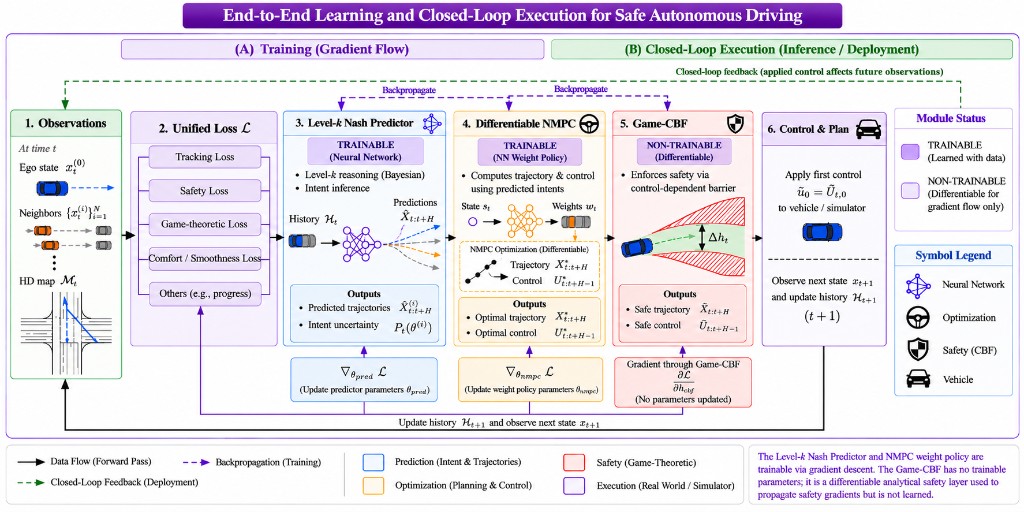
Closed-Loop Integration
We propagate Level-k forecasts into both the Diff-MPC objective and a predicted-state safety margin, so the same interaction information jointly shapes tracking preferences and clearance.
Differentiable Stack
LkNP and the weight-adaptive Diff-MPC are jointly trained. A parameter-free, differentiable Pred-CBF lets tracking and safety losses propagate through KKT sensitivities to both learned modules.
Adaptive Safety-Margin Control
ASMC jointly selects MPC cost weights and an agent-aware runtime margin scaling for Pred-CBF, with a safe floor that never relaxes the margin below the fixed Pred-CBF baseline.
Expanded Validation
nuScenes mini-val prediction, eight urban closed-loop scenarios, a 40-scenario IDM expansion, a strategic L0/L1/L2 matrix, robustness studies, and a five-seed Interaction-RL ablation.
Methods
Level-k Interaction-Conditioned Predictor (LkNP)
A shared transformer encodes agent histories, cross-attends to the ego Level-1 forecast to form a Level-2 representation, then outputs multimodal trajectories and a policy-type posterior over {L0, L1, L2}. The Level-k recursion is an inductive bias amortised by attention.
LkNP CodeDifferentiable Weight-Adaptive MPC (Diff-MPC)
A learned policy πθ maps interaction forecasts to MPC cost weights. The NMPC solution is differentiable with respect to those weights via implicit differentiation (KKT / IFT), so a downstream task loss can train the weight policy end-to-end.
Diff-MPC CodePredictive Control Barrier Function (Pred-CBF)
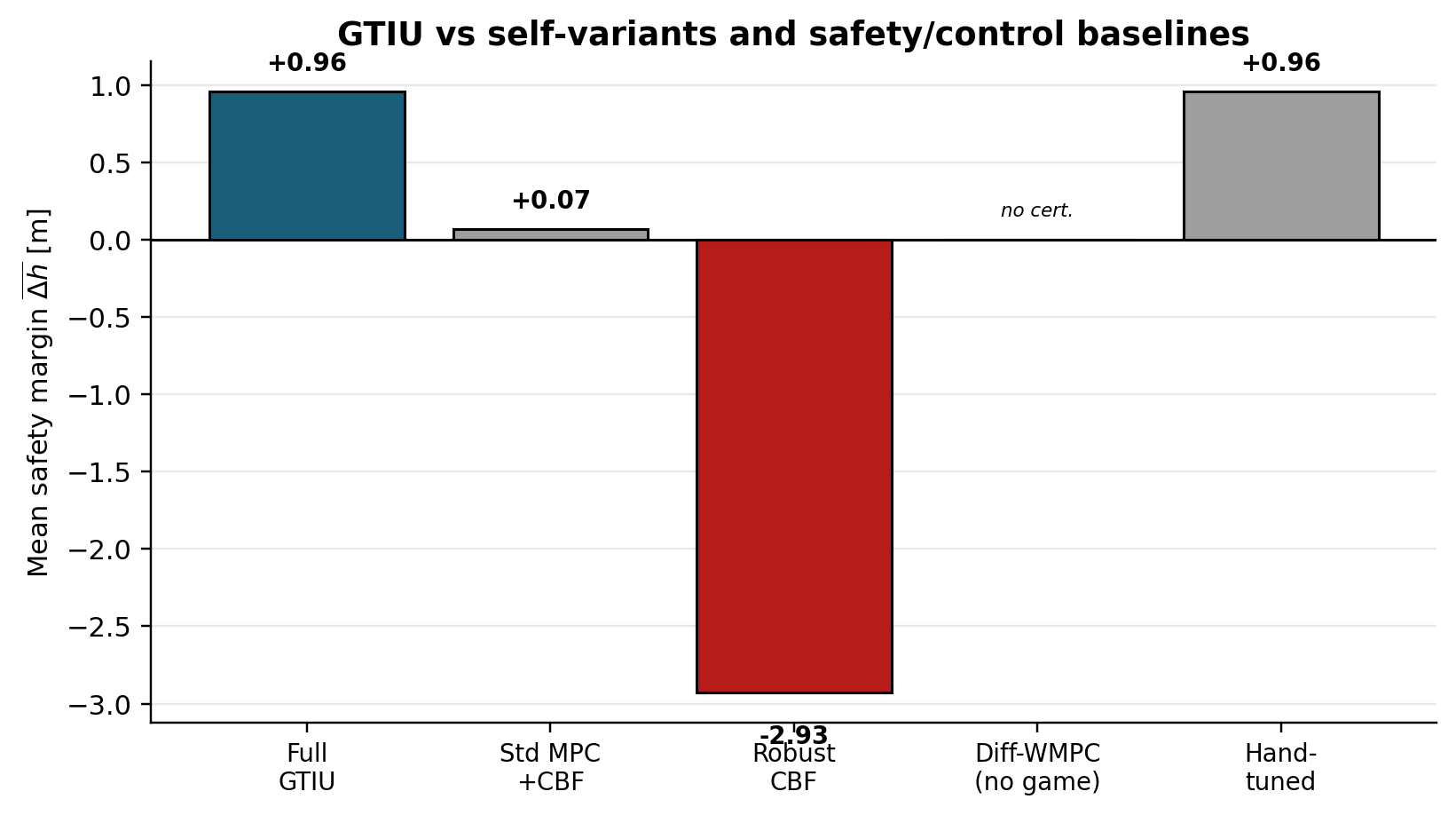
Enforces a classical CBF inequality of the ego dynamics relative to frozen Level-2 predicted positions for that solve. It is a prediction-conditioned barrier, not a fully coupled ego–agent game CBF. No trainable parameters; gradients still flow through it during training.
Pred-CBF CodeAdaptive Safety-Margin Control (ASMC)
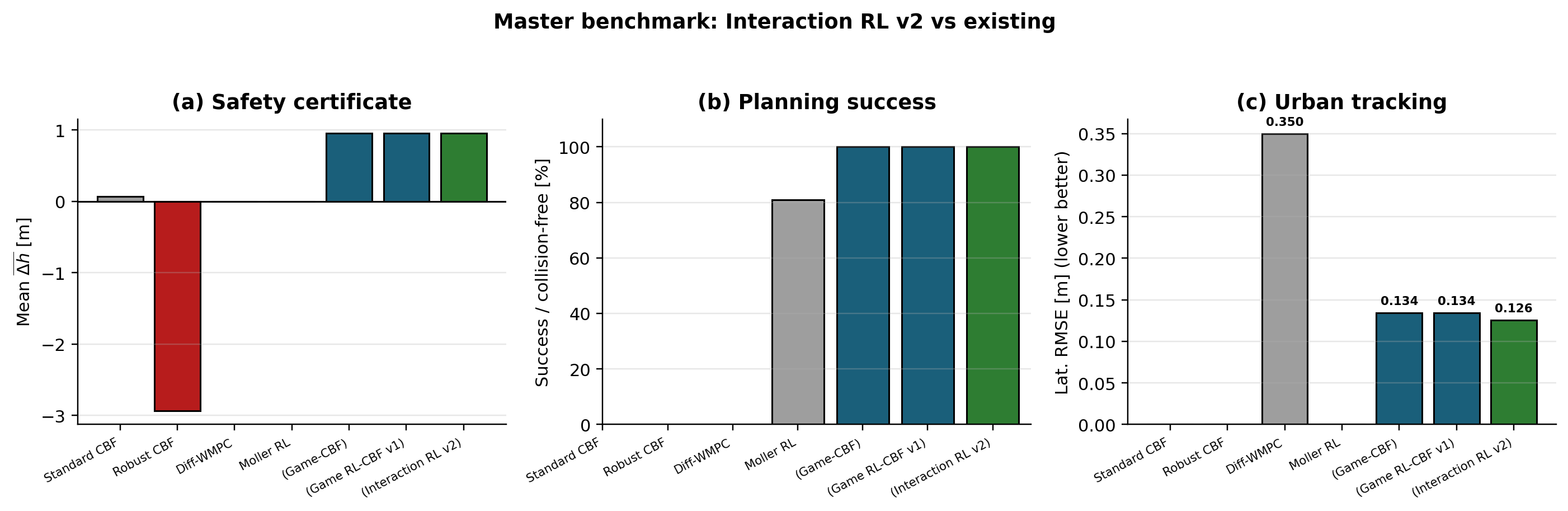
Dual-adaptation policy that jointly tunes MPC weights and an agent-aware runtime margin scaling, never relaxing below the fixed Pred-CBF floor. On eight urban scenarios this reduces lateral RMSE 0.134 → 0.126 m and velocity RMSE 5.39 → 4.38 m/s.
ASMC Code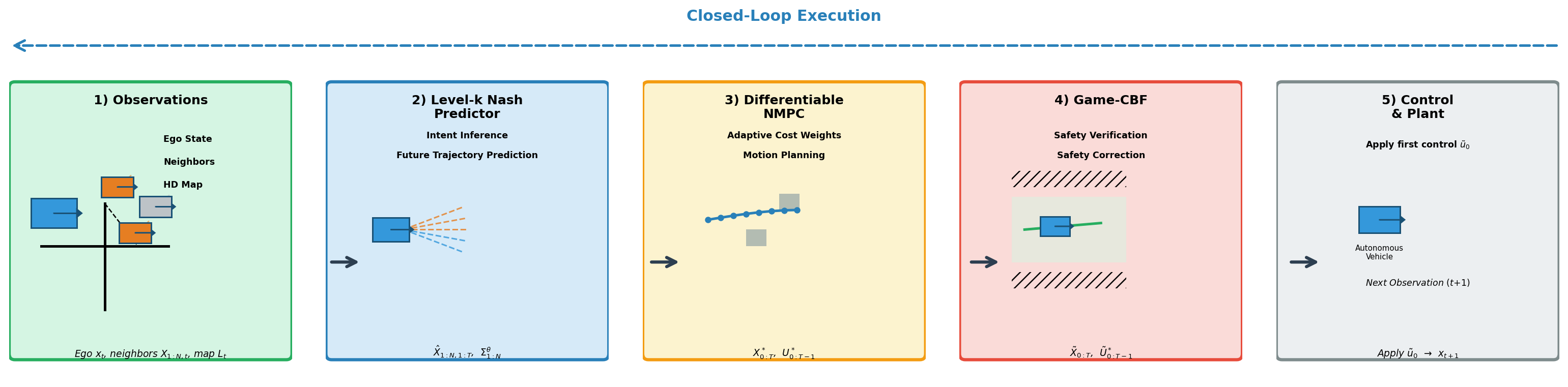
Closed-Loop Experiments
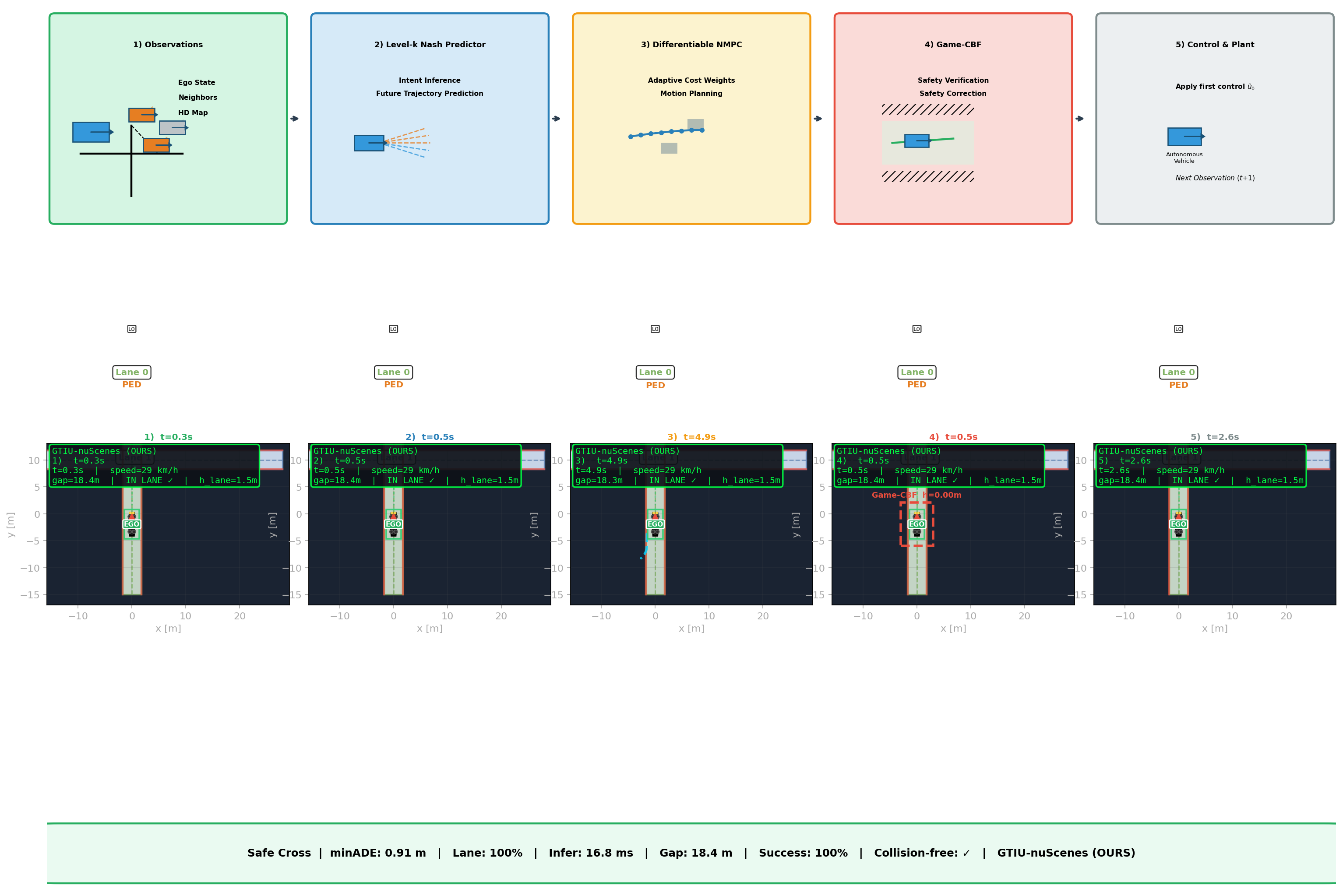
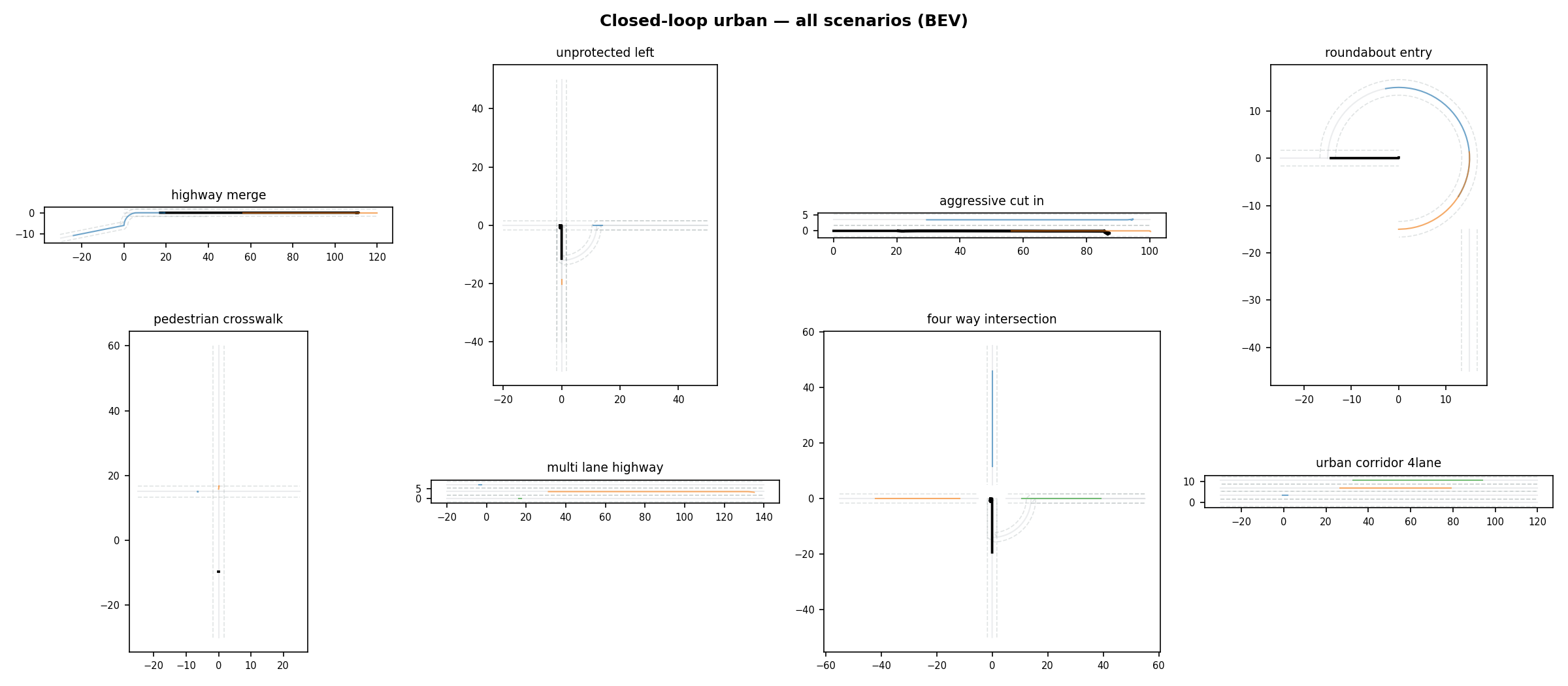
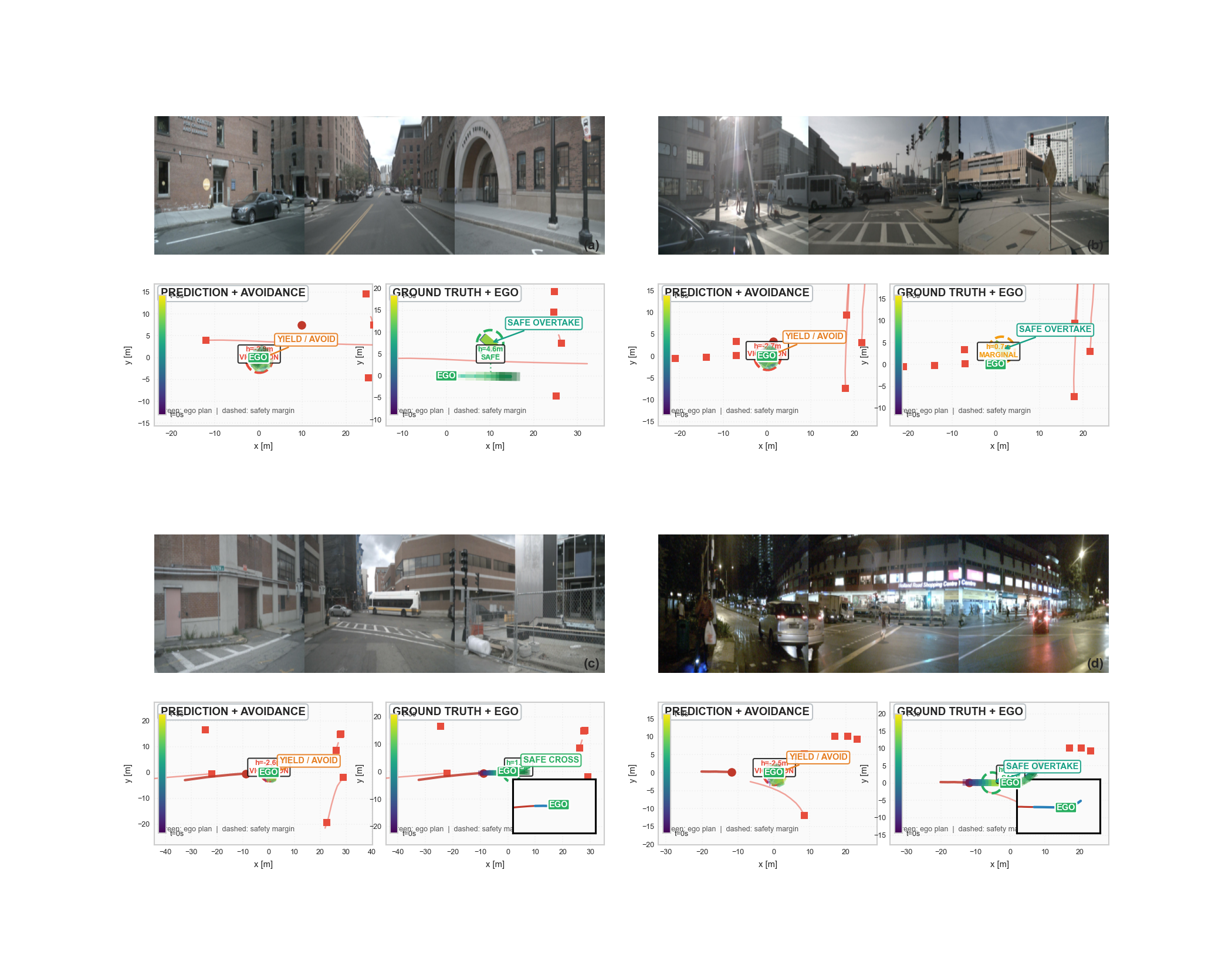
Bird’s-eye rollouts of the full stack: observe → Level-k predict → Diff-NMPC → Pred-CBF → plant. GTIU stays in-lane and collision-free, with a positive clearance gap on every catalog scene. Click a plot or storyboard to enlarge.
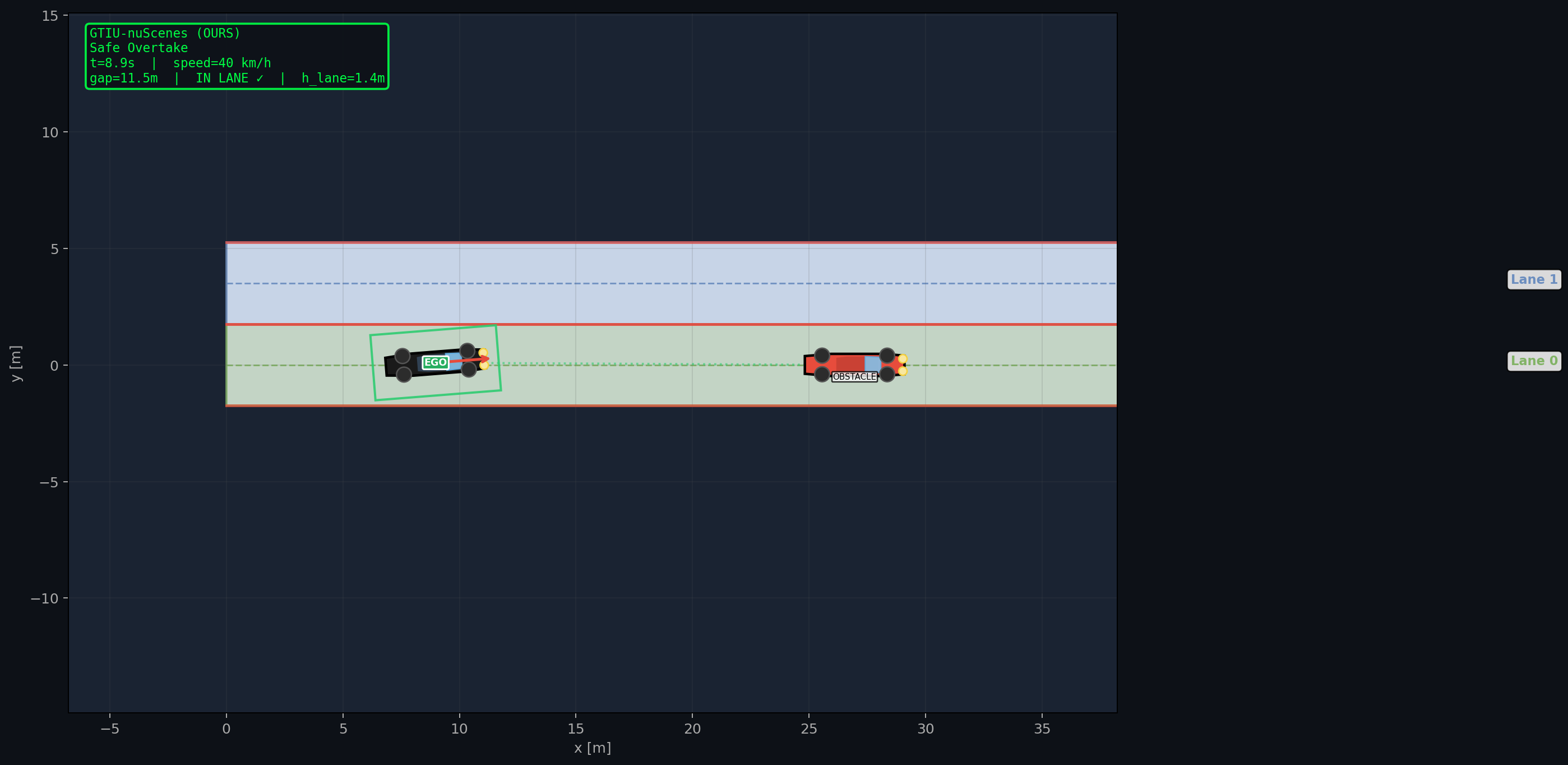
BEV snapshot: t = 8.9 s · 40 km/h · gap 11.5 m · in-lane · Game-CBF margin 1.4 m.
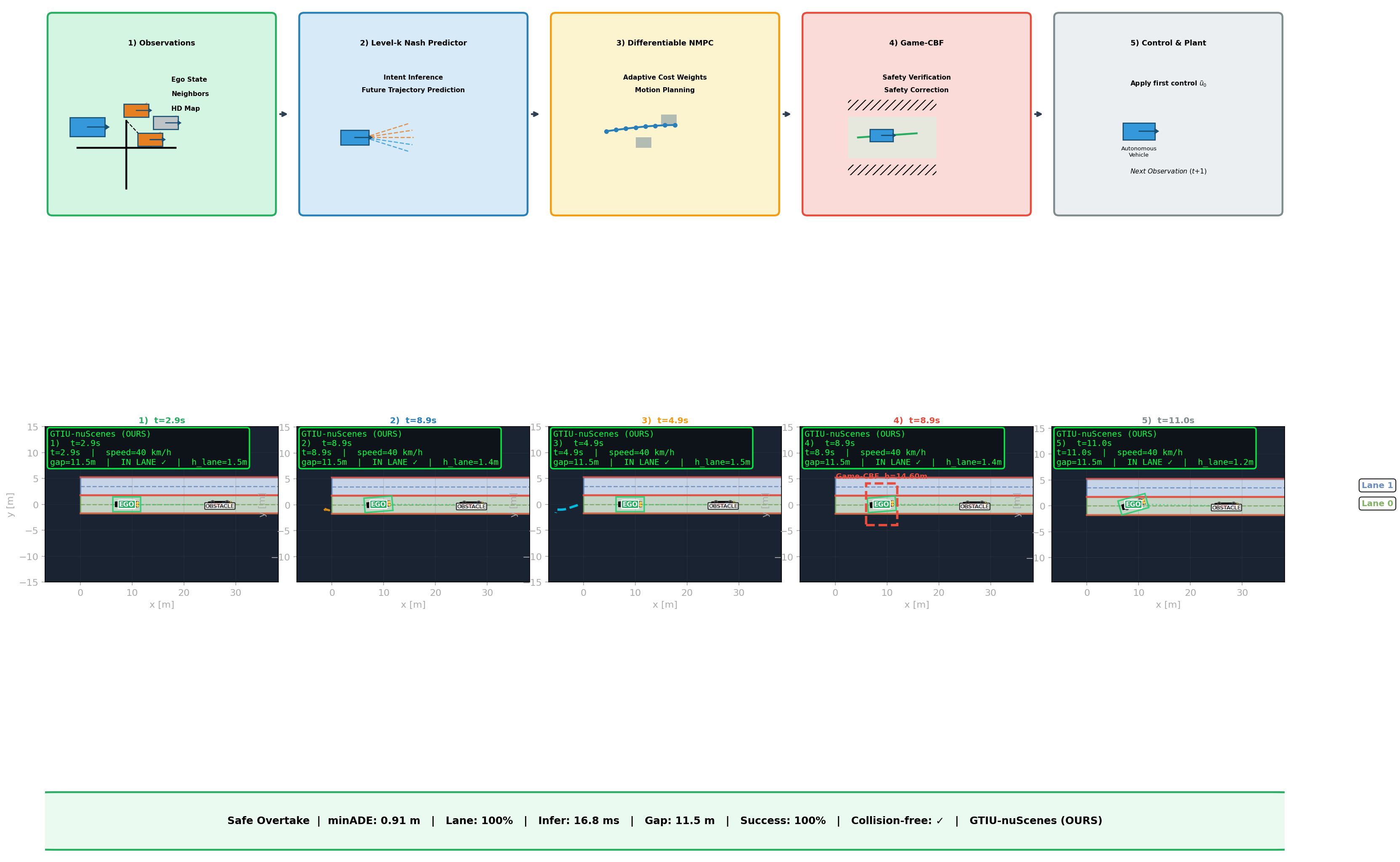
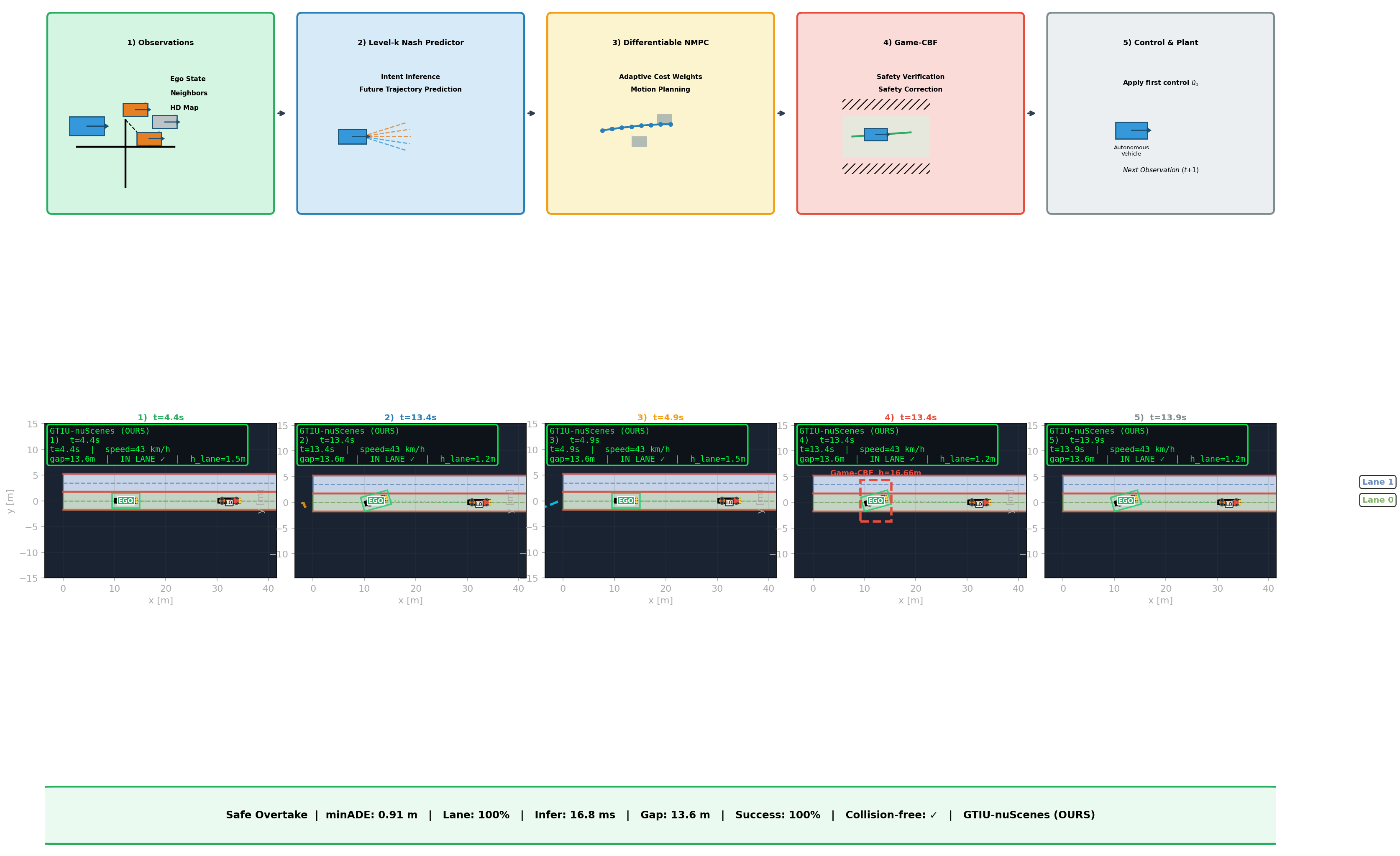
BEV snapshot: ~40 km/h · gap 13.6 m · in-lane · Pred-CBF blocks an unsafe close-in.
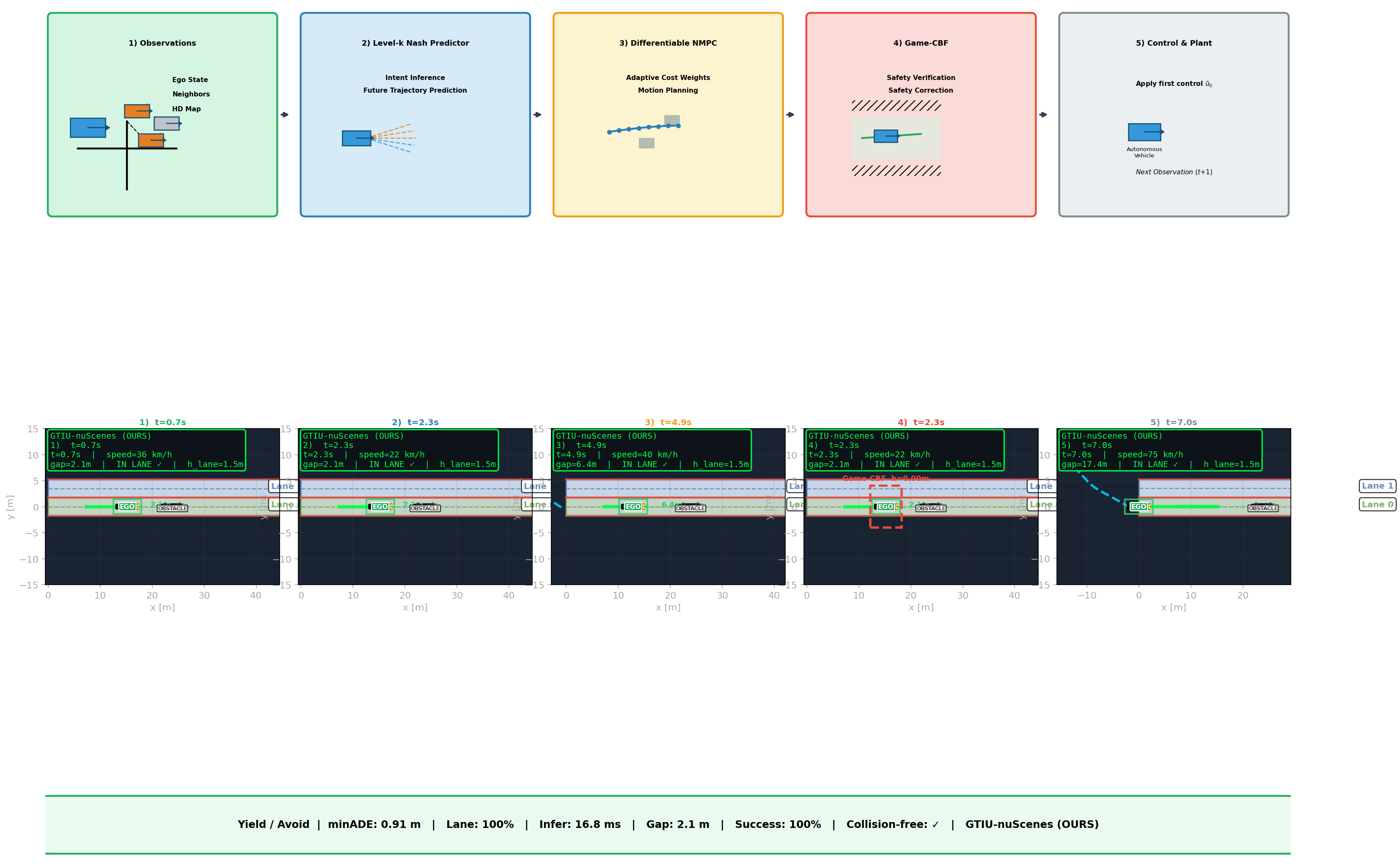
Closest point: gap 2.1 m. The barrier fires (red box), the ego yields, then recovers.
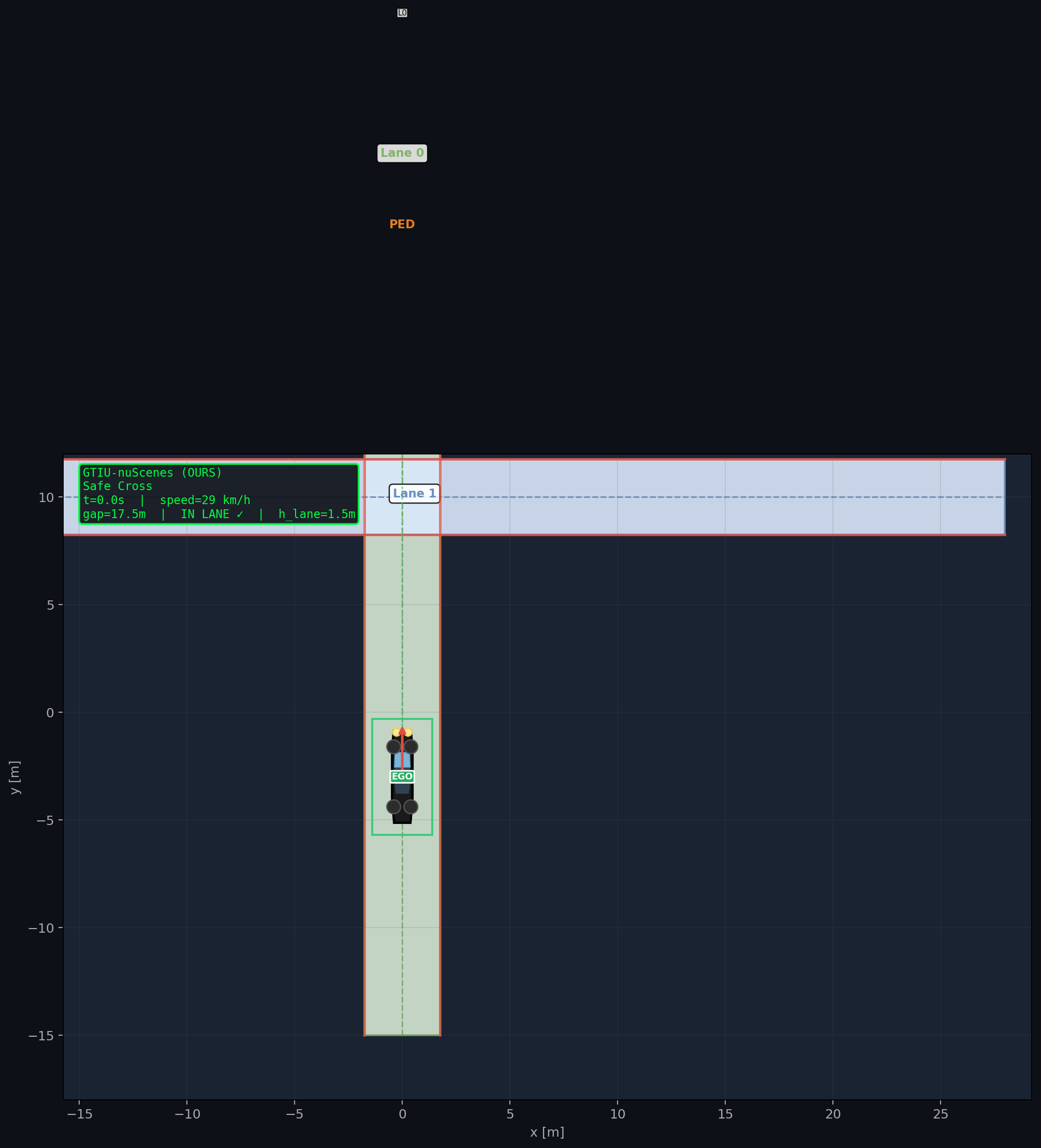
Safe cross: gap 18.4 m · 29 km/h · Pred-CBF margin 0.00 m at the decision instant, then recovery.
Result Plots
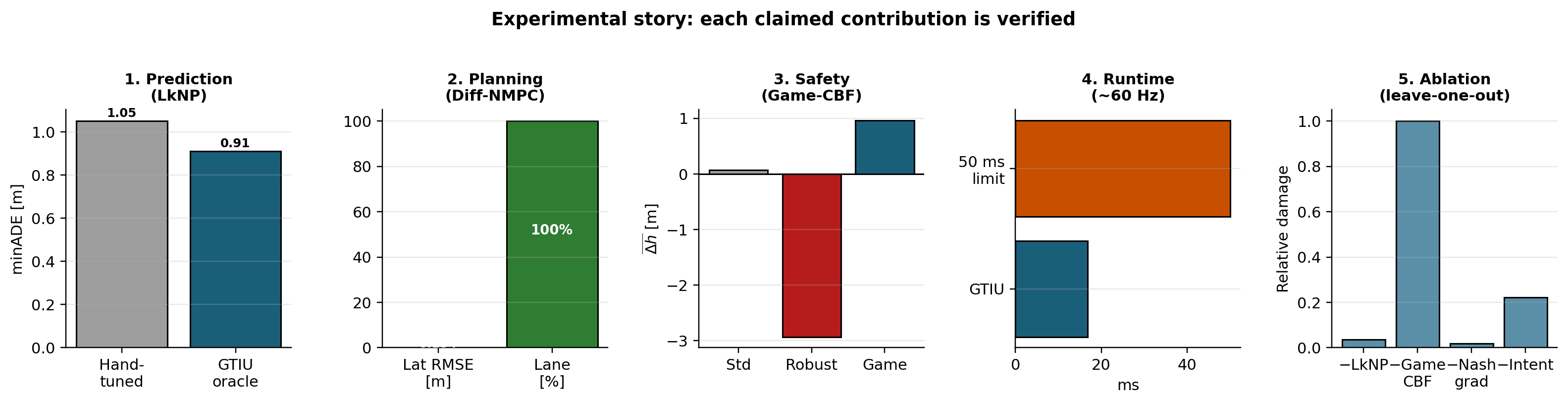
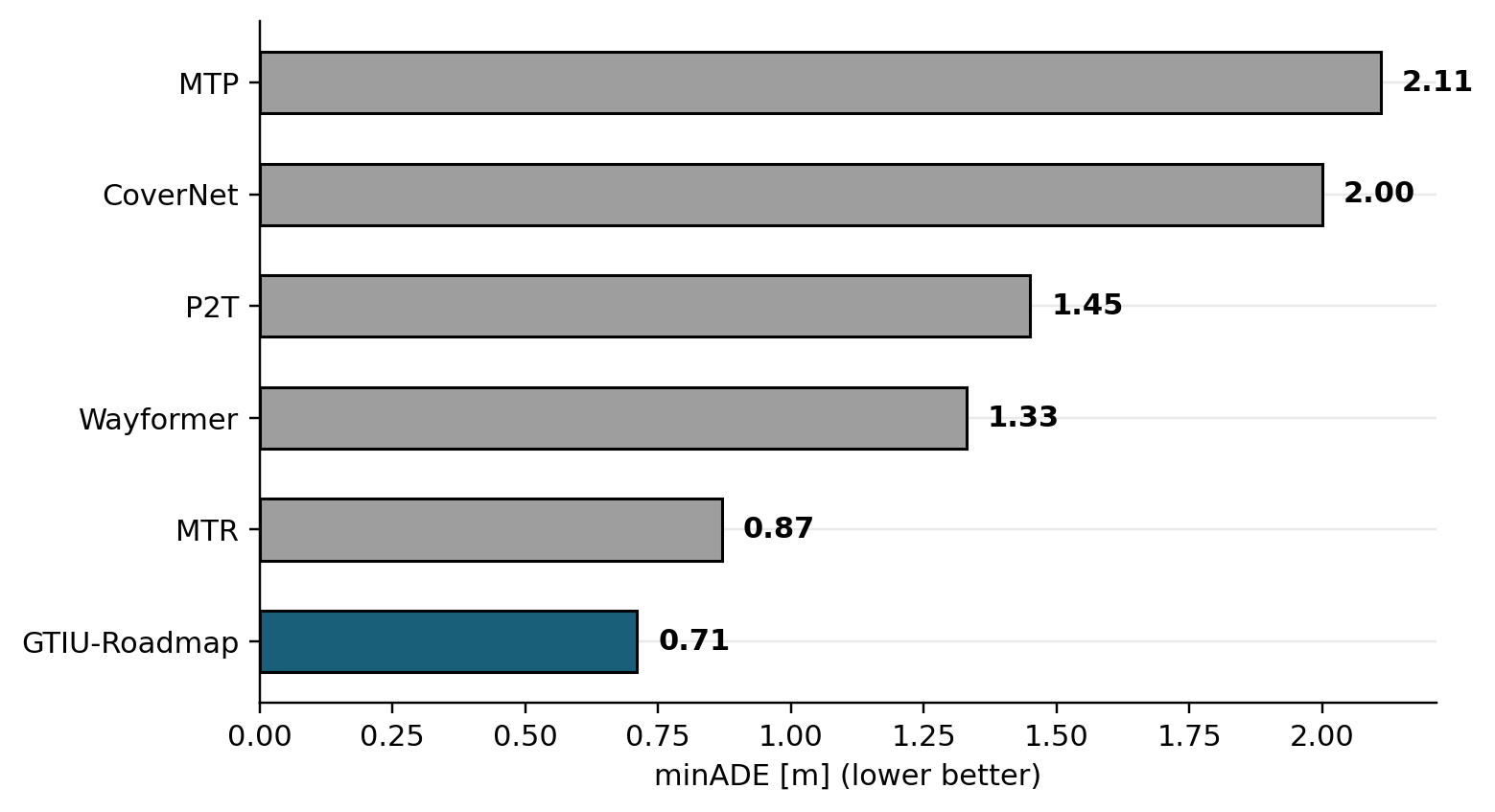
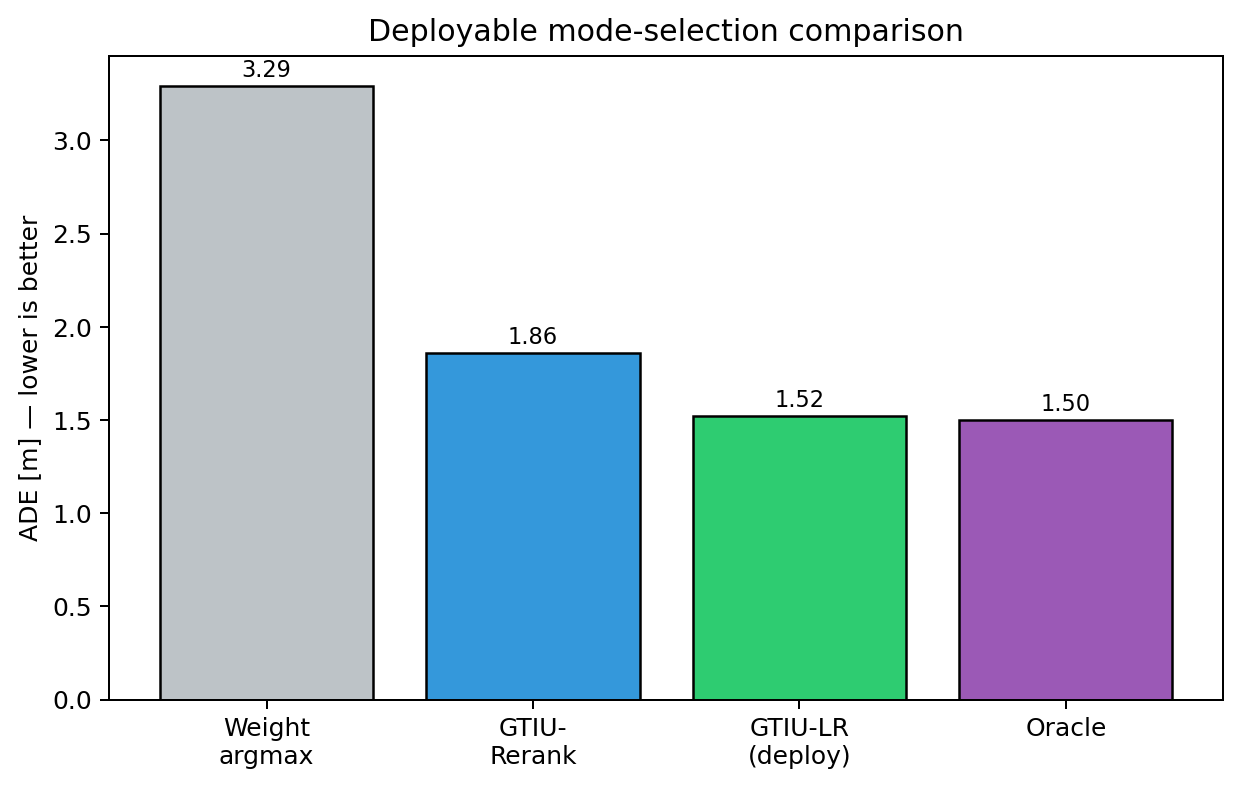
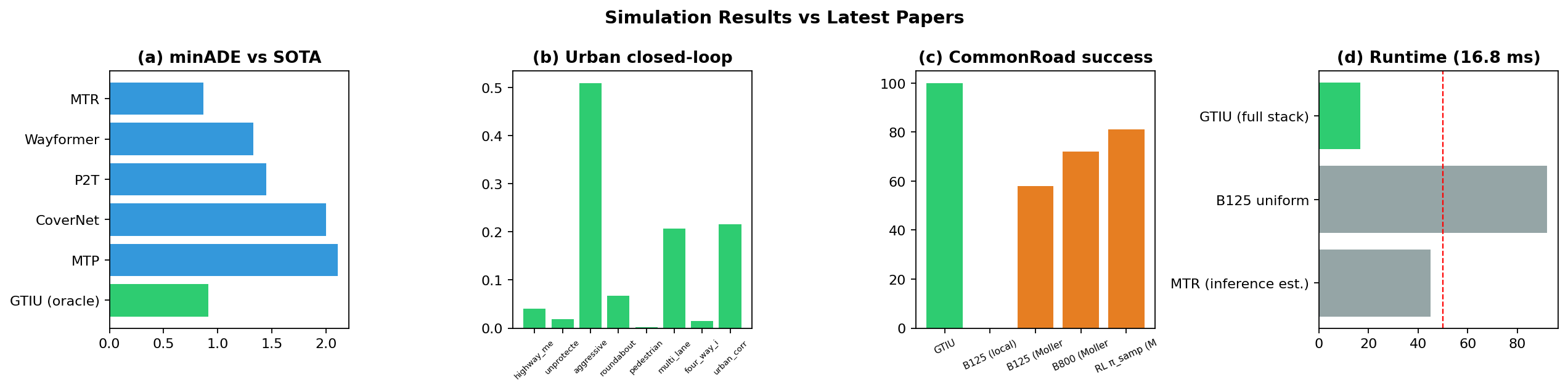
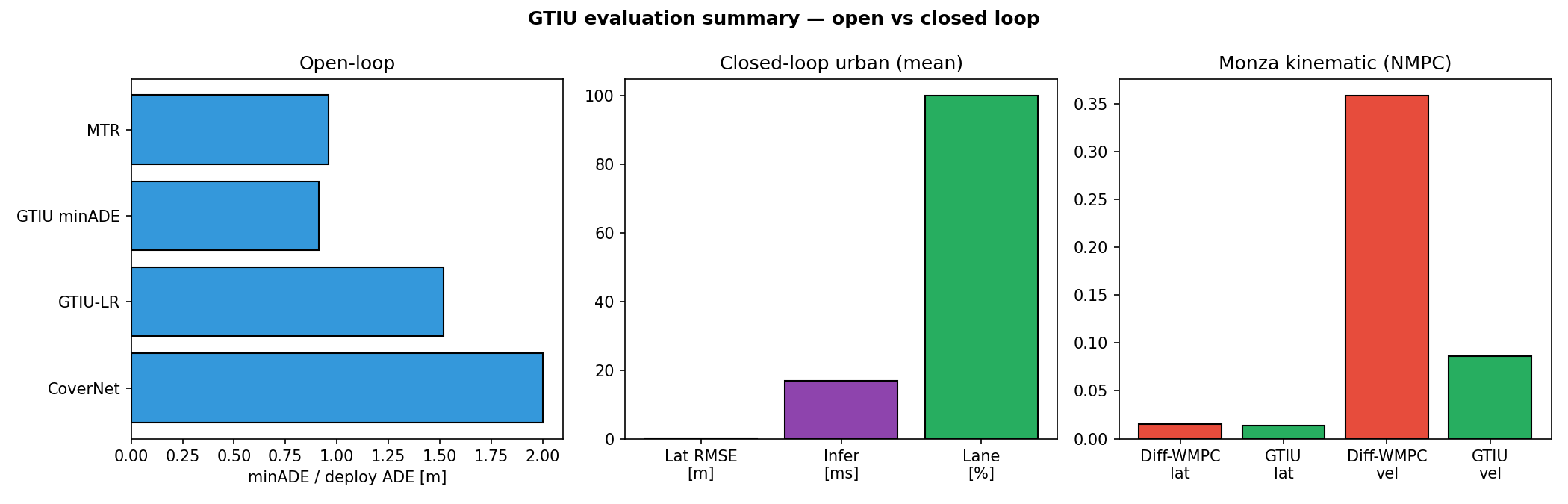
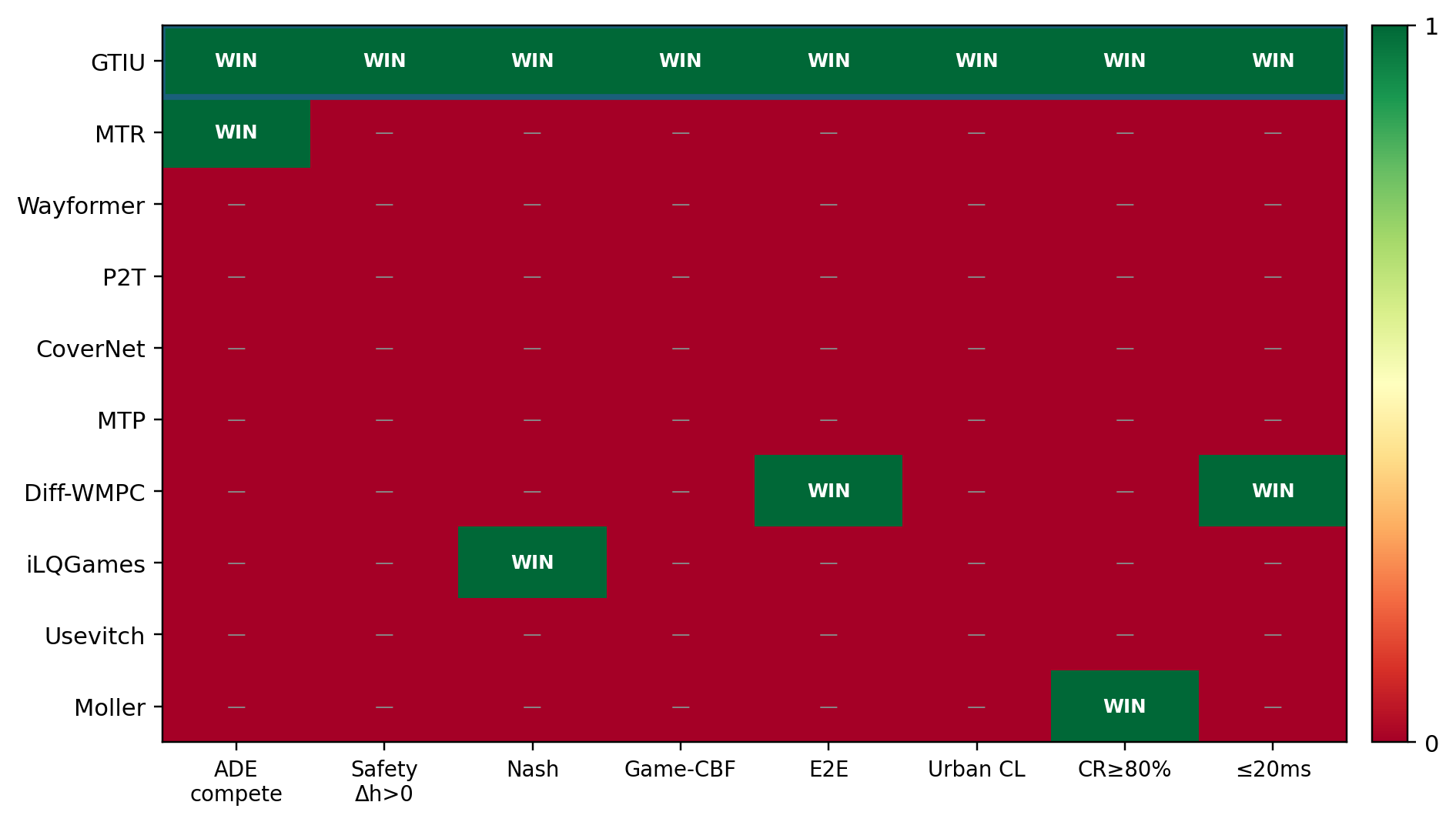
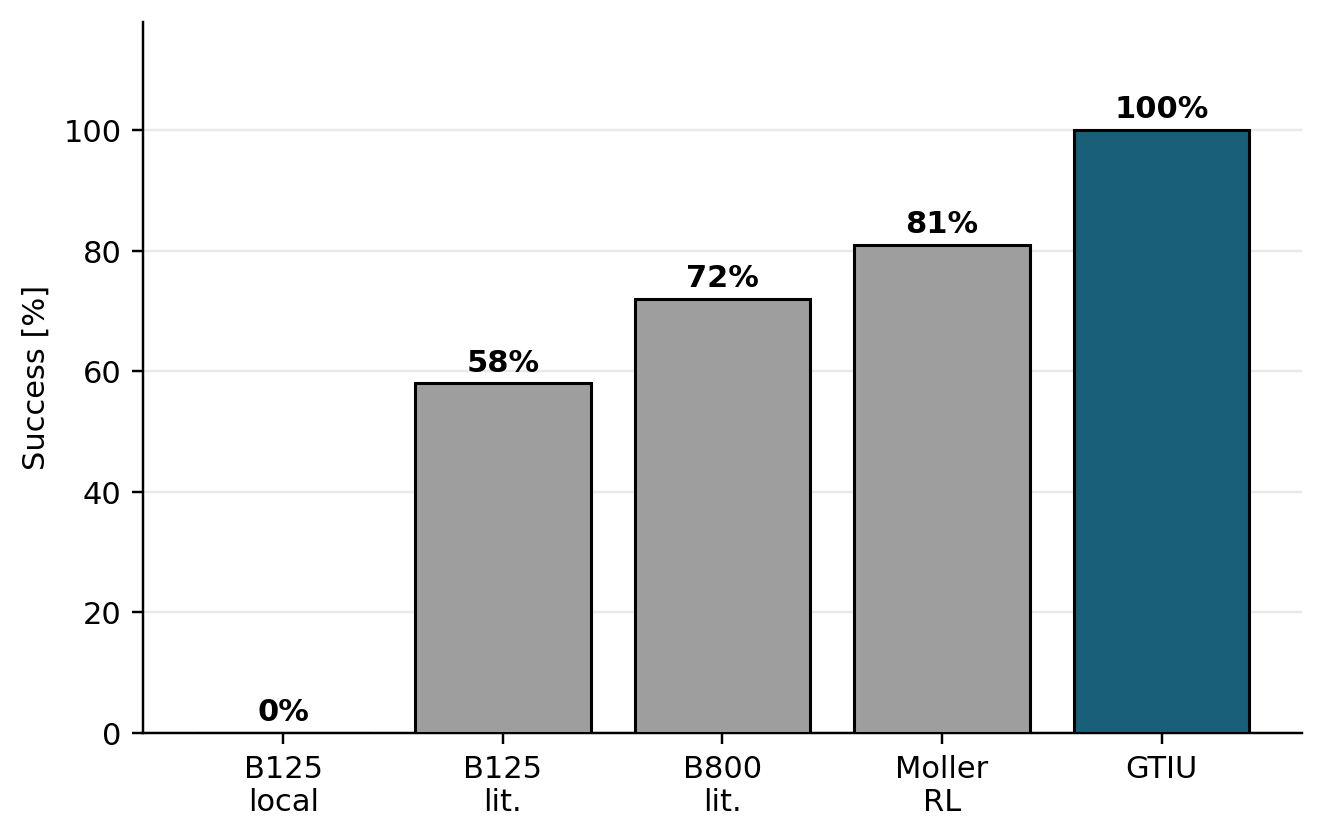
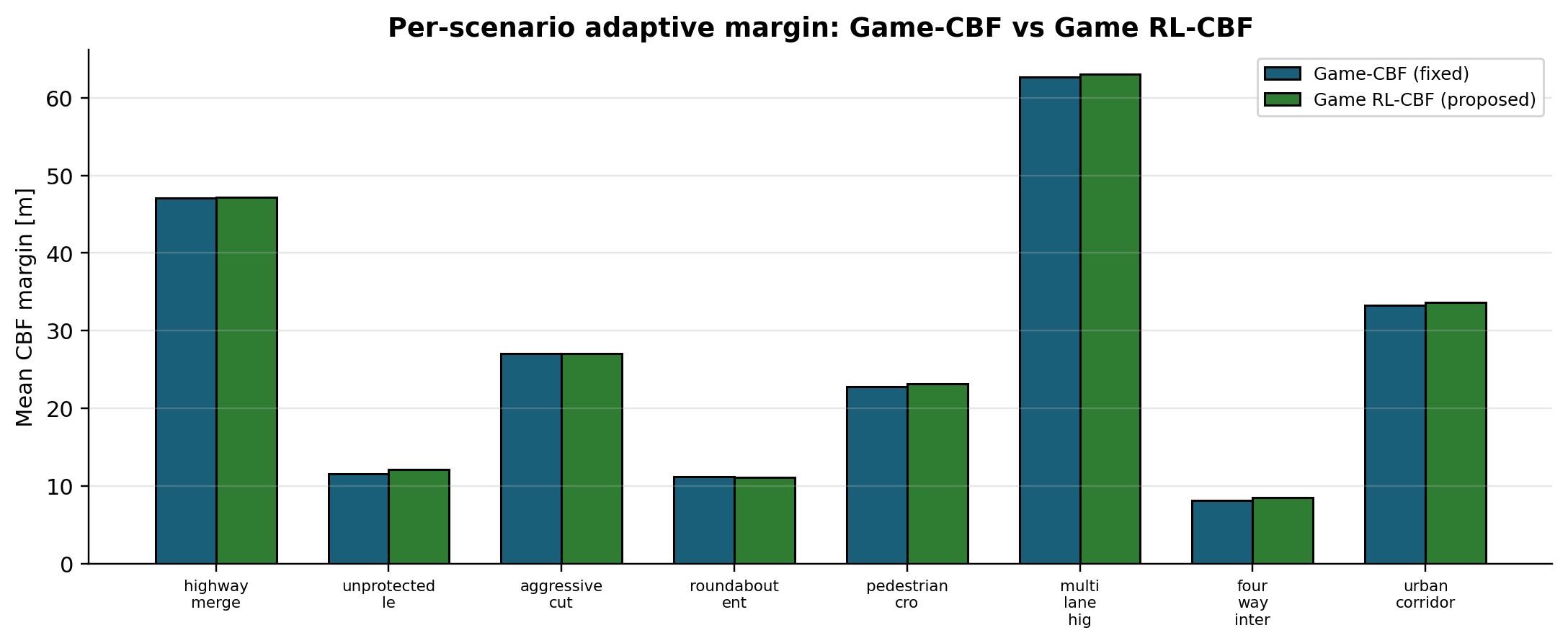
Headline comparisons from the GTIU experiments. Click any plot to enlarge. Mini-val is not a full nuScenes-val SOTA claim; lane and collision rates are saturated, so we emphasise minADE, margin, gap, and tracking error.

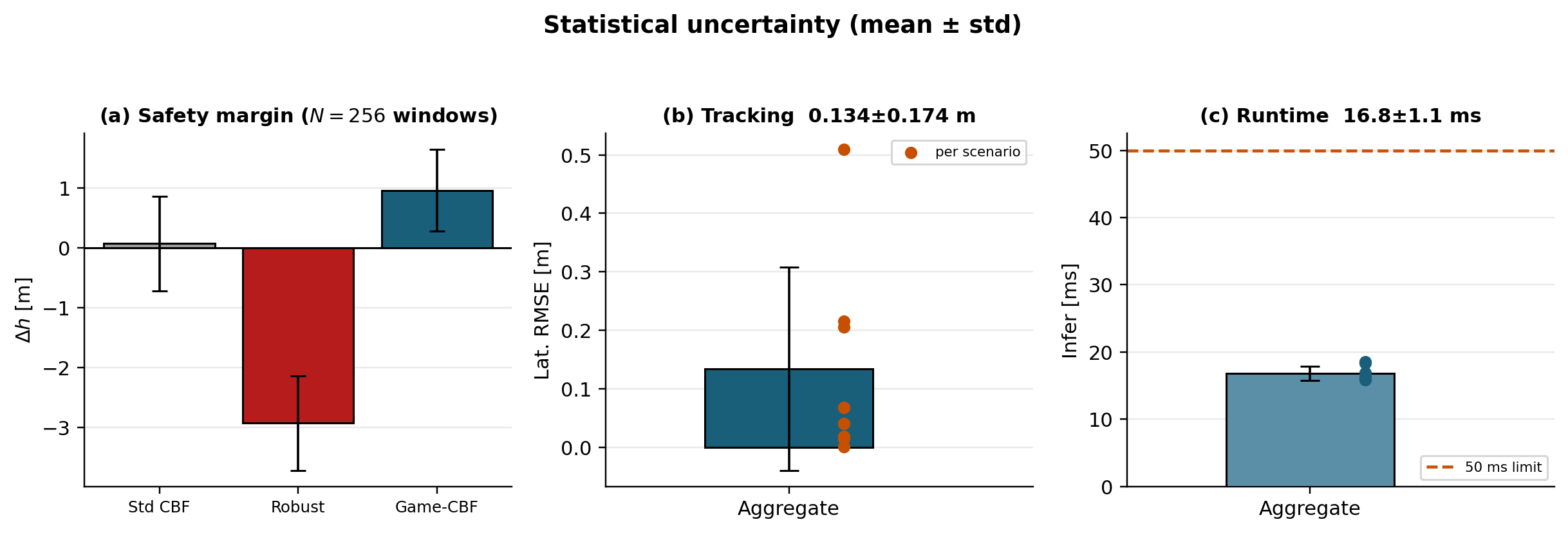
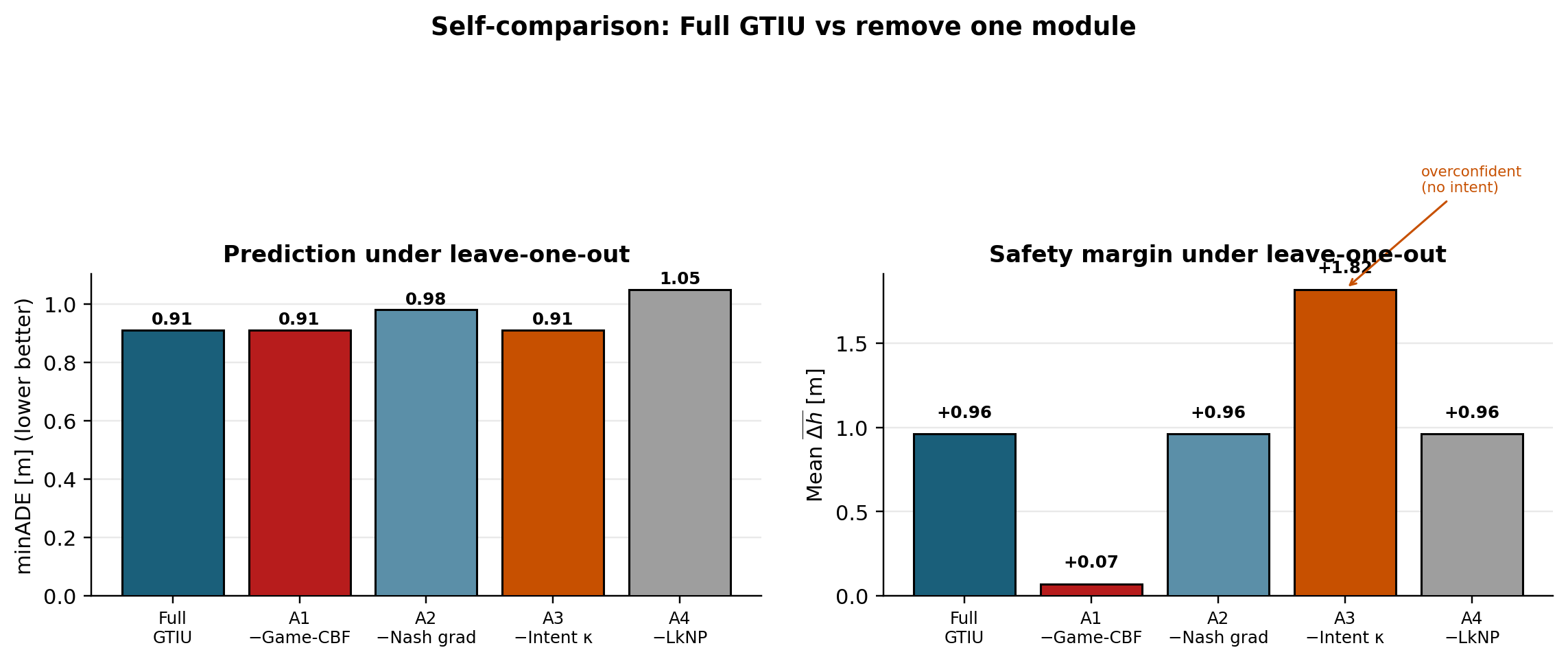
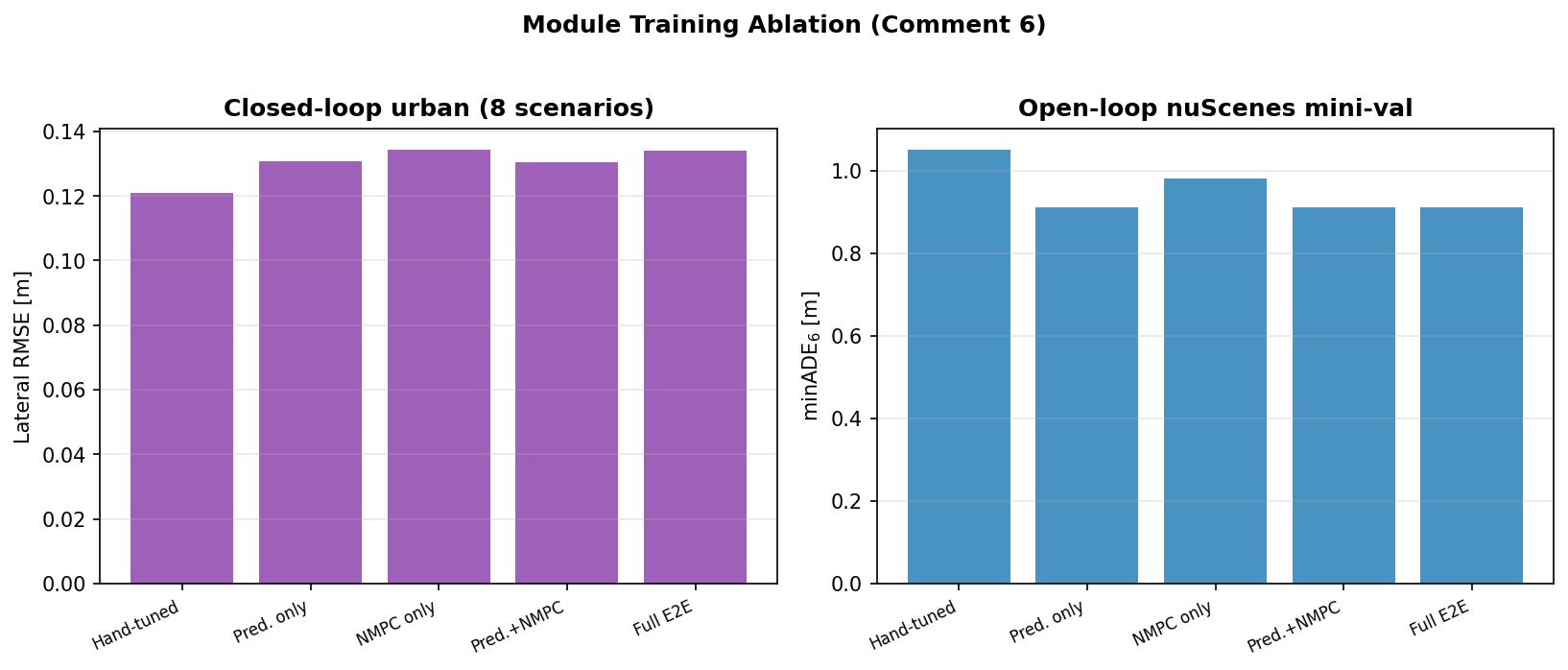
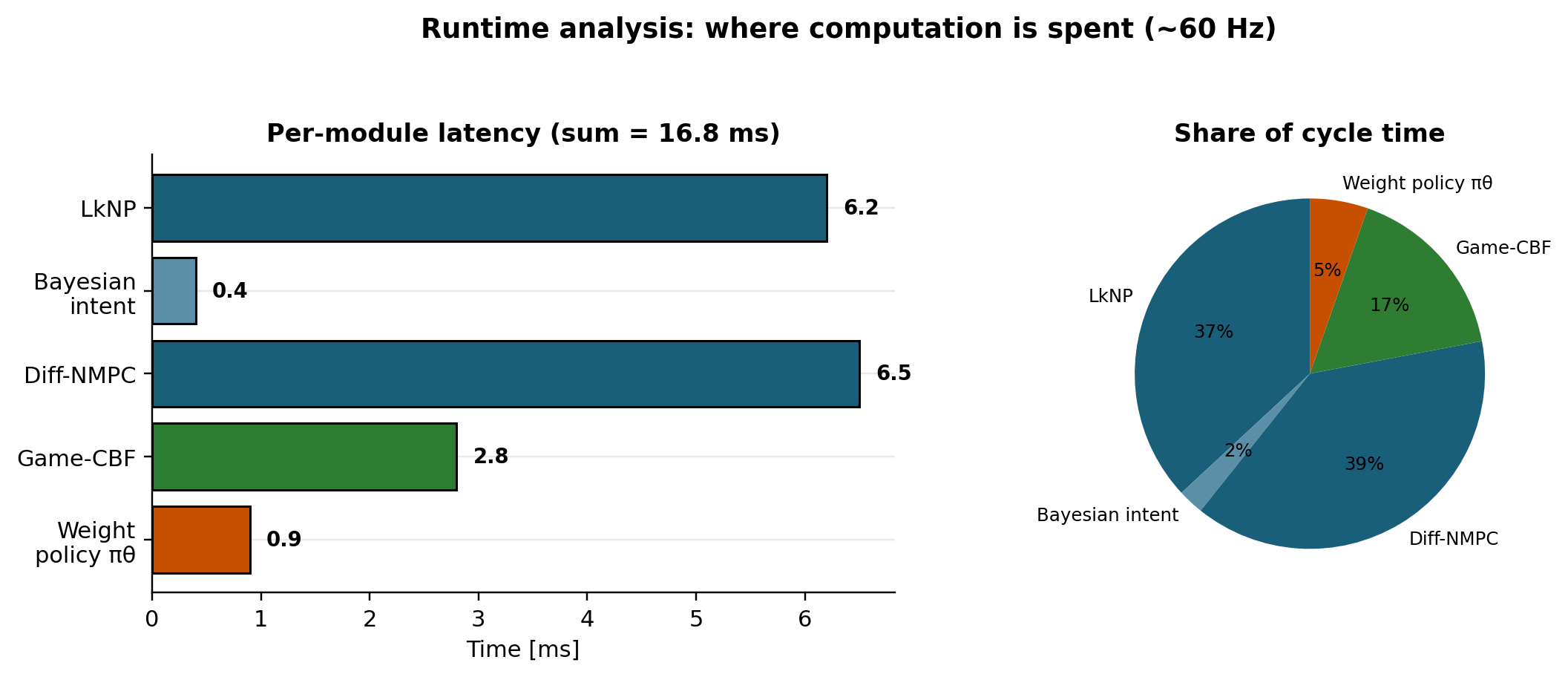
Quantitative Results and Benchmarking
The overall best closed-loop performance is achieved by the full GTIU stack with ASMC, running at 15.8 ms per cycle (≈ 63 Hz) on the reported hardware.
Open-loop path prediction on nuScenes mini-val
N = 256 agent windows, 10 mini scenes. Lower is better. GTIU attains the lowest same-split minADE6 and minFDE6.
| Method | minADE6 ↓ | minFDE6 ↓ | ADE ↓ | MR@2 m ↓ |
|---|---|---|---|---|
| MTP-style anchor | 1.18 | 2.33 | 1.39 | 0.35 |
| Const. speed/yaw | 1.39 | 2.73 | 1.39 | 0.96 |
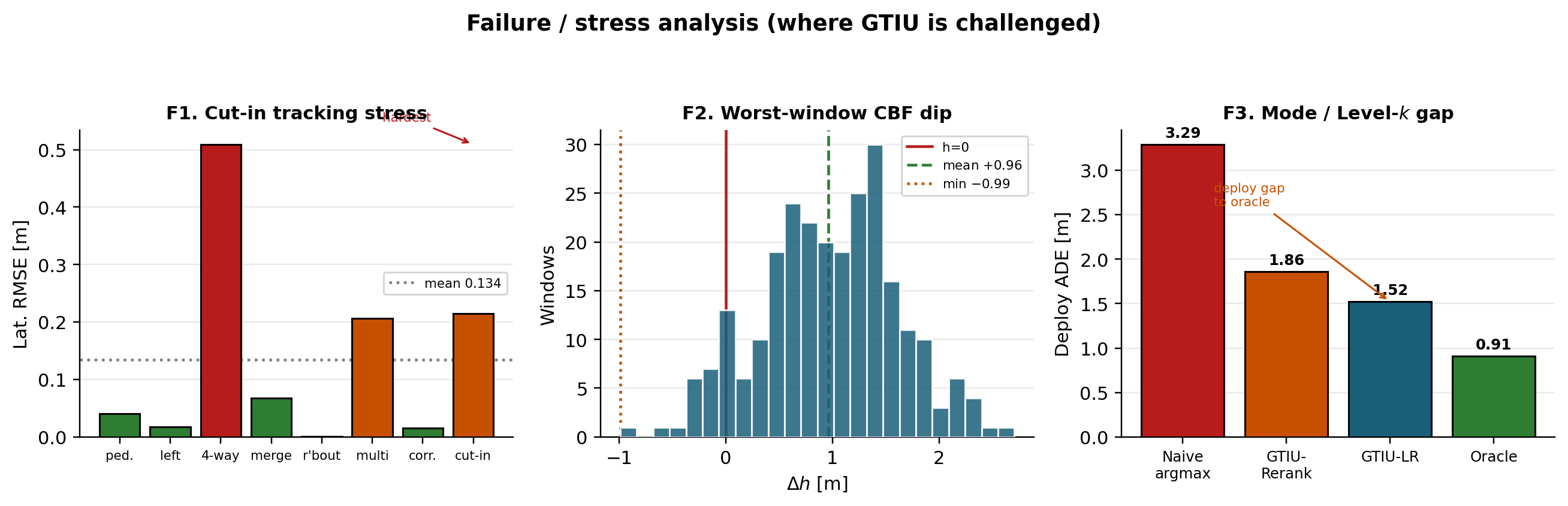
| GTIU-MOCL (baseline) | 0.91 | 2.60 | 3.29 | 0.98 |
| GTIU-Roadmap (ours, oracle) | 0.71 | 1.29 | 2.50 | 0.25 |
| GTIU-LR (ours, deployable) | 0.71 | 1.29 | 1.52 | 0.98 |
ADE is not the same as minADE6. Roadmap ADE (2.50 m) is mixture / primary-mode ADE; minADE6 is hindsight best-of-6. GTIU-LR ADE (1.52 m) is the deployable top-1 prediction handed to the controller. Mini-val is not a full nuScenes-val SOTA claim.
Closed-loop self-ablation on 8 urban scenarios
Lane compliance and collision-free rate are saturated at 100% for all variants, so they are secondary. ASMC reduces lateral RMSE by 6% and velocity RMSE by 19% versus fixed Pred-CBF.
| Variant | Lat. RMSE [m] | Vel. RMSE [m/s] | Lane [%] | Coll. [%] | Margin [m] |
|---|---|---|---|---|---|
| Pred-CBF (fixed) | 0.134 | 5.39 | 100 | 100 | 27.97 |
| Agent-Aware Pred-CBF | 0.134 | 5.39 | 100 | 100 | 28.25 |
| ASMC (ours, best) | 0.126 | 4.38 | 100 | 100 | 28.05 |
Secondary closed-loop safety metrics
Worst-case minimum gap is 2.15 m on this set. Minimum gap and CBF margin are the discriminating safety metrics.
| Variant | Lat. RMSE | Vel. RMSE | Worst min gap [m] | min hCBF |
|---|---|---|---|---|
| Fixed Pred-CBF | 0.134 | 5.39 | 2.15 | 8.78 |
| Agent-aware Pred-CBF | 0.134 | 5.39 | 2.15 | 8.67 |
| ASMC (GTIU) | 0.126 | 4.38 | 2.15 | 8.76 |
Per-scenario closed-loop metrics (full GTIU stack)
| Scenario | min gap [m] | Mean margin [m] | Lat. RMSE | Vel. RMSE |
|---|---|---|---|---|
| highway_merge | 2.15 | 47.3 | 0.040 | 3.70 |
| unprotected_left | 2.15 | 11.6 | 0.018 | 5.18 |
| aggressive_cut_in | 2.15 | 27.3 | 0.509 | 7.49 |
| roundabout_entry | 8.49 | 11.5 | 0.068 | 2.45 |
| pedestrian_crosswalk | 19.06 | 22.8 | 0.001 | 2.01 |
| multi_lane_highway | 2.87 | 62.8 | 0.206 | 6.30 |
| four_way_intersection | 4.60 | 8.3 | 0.015 | 5.08 |
| urban_corridor_4lane | 2.17 | 33.3 | 0.215 | 2.35 |
Aggressive cut-in is the tracking outlier (0.509 m lateral RMSE). Several scenarios share the 2.15 m floor on minimum gap.
Inference latency
| Method | Latency [ms] ↓ | Rate [Hz] ↑ |
|---|---|---|
| GTIU (ours, full stack) | 15.8 ± 0.22 | 63 |
| MTR | 45.0 | 22 |
| Diff-WMPC | 8.0 | 125 |
GTIU: mean ± std over 104 cycles (batch size 1, i7-12700K, RTX 3080, PyTorch 2.1 / CUDA 12.1); 95th percentile 16.1 ms. Hardware-specific; not a real-time certification.
BibTeX
@misc{Singh2026GTIU,
  author={Singh, Anand and Betz, Johannes and Piccinini, Mattia},
  title={Differentiable Nash Planning with Adaptive Probabilistic Safety Certificates Under Interactive Uncertainty},
  year={2026},
  note={manuscript in preparation}
}